Technical notes following a successful repair of my vintage Ensoniq ESQ-1 (S/N ESQ500934-S) that was initially unresponsive with a blank display and no sound from the keyboard or via MIDI.
Initial inspection
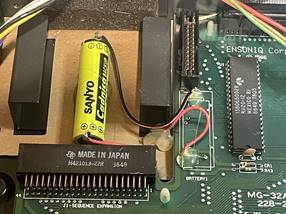
After opening the case, my Initial inspection showed power supply voltages were close to correct levels but backup battery voltage was very low at (0.2V) vs the typical 3.5V expected. The odd placement of the NiCad battery, hot glued inside a cartridge-slot suggested it was probably retrofitted at some point. Screws that secured the power supply bracket to the metal case were missing.
Checking for system reset and installing a BMD 65003 keyboard scanner / display chip
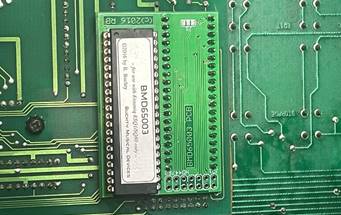
Oscilloscope showed that the main board was generating a valid reset signal from U8 pin 7. The CPU (6809) and supporting chips appeared to be active. At power-on the UART (2681) appeared to send a burst of data to the display chip on pin 11. Probing the 6500/11A display and keyboard scanner MPU at power on, showed the short burst of data appeared on pin 23 (DSPIN) - which likely represents a clear display instruction or the welcome message the ESQ-1 displays during start up. The 6500/11A chip crystal was oscillating but most other pins were stuck. The pins 31 – 38 that should output display information showed no signs of activity. As this (notorious) display chip has been documented as a common failure, and it appeared quite dead, I concluded it was very likely to be the cause of the blank display. The original part is obsolete and near impossible to obtain, so I replaced it with an OEM chip and adaptor board BMD 65003 from Buchty Musical Devices. After replacement the VFD display worked properly, as did the control panel buttons but still no sound output.
Checking the voice-select and signal distribution circuits
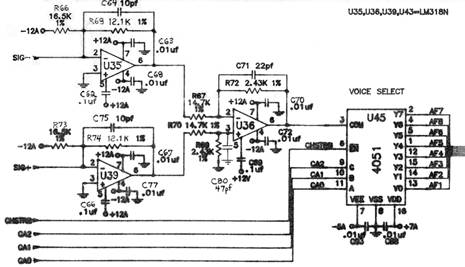
I checked U45 (CD4051) is an analog demultiplexer that passes multiplexed audio signals generated by the DAC to the bank of 8 x CEM3379 chips that manage filtering and sound shaping. The common input is pin 3. A binary count on the 3 output-select pins (9,10 and 11) cycles through the 8 outputs, so the de-mux slices up the input signal. This section appeared to be working as expected.
Checking the voice control signals
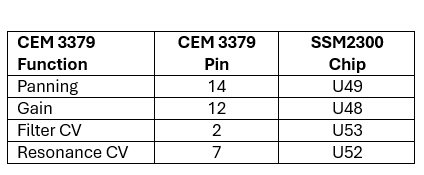
A multiplexed control voltage from the DAC chip passes through U56 to the input of 4 x SSM2300 sample and hold chips on pin 3. The complex incoming signal is demultiplexed into 8 output voltages by the chips using pins 9,10,11 to sequentially select outputs (0-7) which are enabled by pin 8. The sample and hold function ensure the 8 output voltages are held steady between cycles and used to control the VCA, VPAN, VFC, VQ parameters used by the CEM3379. Checking the output of the 4 x SSM2300 chips revealed U53 was dead and quite hot to the touch compared to the others. Replacing this chip with one of the others restored some sound. I expect it was holding all of the CEM3379 filters closed which was likely blocking the audio signal.
Recapping power supply and repairing cold solder joints
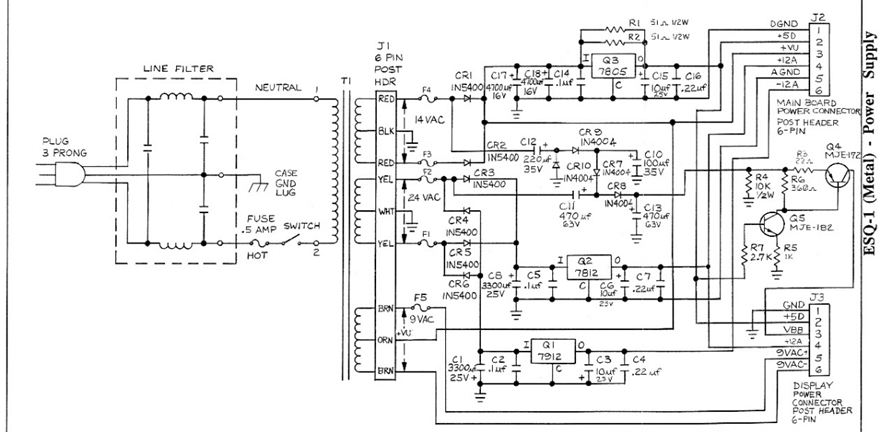
Inspection of power supply revealed several badly soldered joints on filter capacitors likely due to a previous repair attempt. The use of lead-free solder, perhaps with an underpowered soldering iron likely a factor here. Replaced electrolytic capacitors C15, C17, C18 in +5V circuit. Replaced C11, C13, C10 and C12 in the +50V display power circuit. All replacement caps were low ESR types. Bracket secured with replacement screws to ensure better heat transfer and likely cooler operation.
Battery replacement
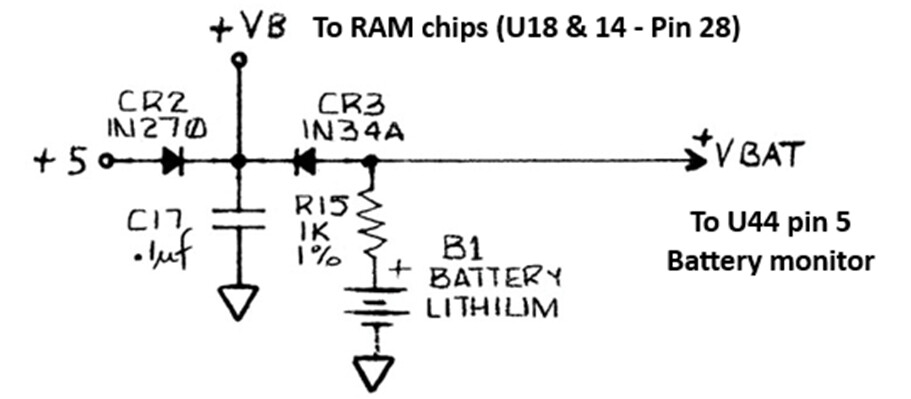
I replaced the NiCad battery with a 3.6V non-rechargeable lithium battery (ER14250H/P) mounted directly on the main board. Note that the battery voltage (VB) supplied to the RAM chips comes from the +5V rail when powered on, but when switched off current flows through diode CR1 instead. The two diodes ensure that the lithium battery is not exposed to an over voltage that could damage it. The +VBAT signal goes to pin 5 of (U44) the 4051 analog multiplexer used to read several voltages used by the system including the pitch bender and modulation controls.
Afterword
At this time, I’m waiting for a replacement SSM 2300 to complete the repair and will update these notes when it’s done. In the meantime, I want to sincerely thank Rainer Buchy for his amazing contribution to the vintage synth community and his ingenious BMD56003. Without a replacement chip for the unobtainable 6500/11A display / keyboard scanner this story would not have had a happy ending. Thank you, Rainer..!